• Home
  • Services
  • Staff
  • Resources
  • Clients
  • Blog
  • Contact
  • Home
  • Services
  • Staff
  • Resources
  • Clients
  • Blog
  • Contact
DARK SKY CONSULTING, LLC
  • Home
  • Services
  • Staff
  • Resources
  • Clients
  • Blog
  • Contact

The Dark Sky Advisory

Back to Blog

Decoding a decade of rising global light pollution

5/1/2026

 
A global overview of
Image credit: Li et al. (2026) / CC-BY-4.0
1480 words / 6-minute read
Images of the Earth at night from space are an important tool to understand light pollution. They allow us to see the "big picture" across our planet at night and how it is changing. But satellite images aren't perfect by any means. Last year we wrote here about the limits of what those images can tell us. We also sometimes struggle to understand what the images mean in relation to the brightness of the night sky. And their designs and capabilities are far from ideal.

Still, satellite measurements are indispensable method in the researcher's kit. In the past decade they told a compelling story. In the mid-2010s, nighttime light emissions seemed to rise worldwide at about 2% per year. There were reasons to think this was a very low estimate. In 2023 an analysis of visual observations of the night sky showed the rate must be much higher.

​According to new research, the picture is even more complicated than we once believed. This month we dive into a recent paper led by Tian Li (University of Connecticut) that gives an unprecedented look behind the curtain. What the authors found was not entirely surprising.

The eye in the sky: seeing the glow but missing the blue

The workhorse instrument for measuring "nighttime lights" is the Visible Infrared Imaging Radiometer Suite, or VIIRS. One of its cameras, called the Day-Night Band (DNB), has a sensitivity that allows it to measure very faint light. As its name suggests, it works well on both the day and night sides of the Earth. At night, it sees the glow of our cities as well as the light of natural phenomena like wildfires and the aurorae. Scientists used information about the artificial lights to learn about patterns of human activity.

The DNB has some limitations. It can only resolve areas on the ground about the size of a city block, nothing smaller. It flies over every part of the Earth at least once a night, but only at certain times. Most important, it does not see light in the blue-green part of the spectrum well (or at all). As modern outdoor lighting emits a lot in these colors, this sense of 'blindness' is significant. In particular, the DNB cannot see much of the light emitted by white light-emitting diode (LED) sources.

Previous studies published in 2016 and 2017 offered some insight despite these flaws. Artificial light at night (ALAN) is widespread across the world. In many respects, it has completely transformed the nighttime environment in some places. And it is growing in brightness and intensity faster than the growth of the human population. Still, until now our view was fragmented in time and space. And an analysis of a longer data series offers fresh insight.

Looking beyond averages in a decade of data

The new paper by Li and coworkers considers the changes of every pixel in every DNB image from 2014-2022. Previous studies dealt only with long-term (monthly or yearly) averages to filter out influences like clouds. Irregular sampling of light data like this tends to "smooth over" short-duration changes. It also makes it difficult to sense whether changes are happening slowly or quickly. Earlier papers thus focused only on long-term changes, almost all appearing as increases.

Li's innovation is a new way of filtering out clouds and other contamination from nightly DNB images. Also, they accounted for the changing angle between the spacecraft and light sources on the ground. This better handles situations like light emitted 'sideways' from illuminated windows of buildings. And thanks to the orbital properties of the spacecraft, the DNB data include virtually all inhabited parts of the world.

What the researchers found is interesting, if not very surprising. Global light emissions increased 34% during the study period. But that surge masks large areas of dimming, which offsets about half of the brightening. The net result? Artificial lighting at night increased worldwide by about 2 percent each year. That is exactly the same rate measured with the same equipment during 2012-2015.

As a global average number, the result doesn't quite capture how dynamic nighttime lights are. According to the Guardian, "night-time light 'surged' in China and northern India along with urban development." Space.com noted volatility in places like Palestine (due to war) and Puerto Rico (due to natural disaster). Big apparent decreases in countries like France may be the result of policies meant to reduce light pollution (although the new research can't say for sure). And not all the change is due to the behavior of electric light. Citing NASA, the Guardian pointed to "intense gas burn-offs, or flaring, over central US regions" of oil and gas production. In short, the picture is complicated at best. 
This figure presents the global frequency and causes of nighttime light changes. Maps A and B show the average number of years each location experienced abrupt or gradual shifts, highlighting high-volatility areas like Texas (gas flaring) and Venezuela (energy instability). Section C contains four donut charts labeled
This figure from Li et al. (2026) illustrates how global night lights changed between 2014 and 2022, highlighting where human activity is becoming more or less intense. Map A shows abrupt shifts often caused by sudden events like conflicts, grid failures, or new construction, while Map B shows gradual trends typically seen in developing or expanding regions. The donut charts in Section C break down the reasons for these changes, revealing that while 65% of sudden changes resulted in brightening, a significant portion of dimming was tied to human-led factors like conflict or economic shifts. Overall, the data reveals a world that isn't just getting brighter, but also much more volatile in its energy use.

Average growth is only half the story

When considered alongside earlier studies, the emerging picture is clear: they all point to a brightening world. The Nature paper by Li and colleagues doesn't change that broad conclusion. And a brightening world involves many social and environmental consequences.

In understanding this, there is an important analogy to global climate change. An objection to the evidence for climate change one hears sometimes is that certain places seem to be getting colder. And that's true: even in a world that gets warmer on average with time, some places get colder. But others get a lot warmer than the average. This is an expected consequence of adding energy to the Earth's atmosphere, raising the average temperature.

​The main takeaway from the Li paper is that patterns of change in light emissions over time and geography vary, and by a lot. The surprising conclusion is that "both brightening and dimming have markedly intensified over the past decade." That's one thing we didn't expect, nor can we quite explain it. And in many parts of the world, rates of both brightening and dimming are increasing together. More research is needed to understand why this is.

Why this matters for dark skies

We need to keep beating the drum about ALAN and light pollution. The new data make clear that the world is leaning on the accelerator, not the brakes. There is a growing realization in the scientific community that light pollution is real pollution. It has harmful effects that can be mitigated through simple actions. When we undertake those actions, we know that they produce the expected results.

To the extent we might ever know what is a "safe" dose of ALAN, if such a thing exists, maps like these are our only way of knowing on a global basis which regions are exceeding it. This has meaningful value for everything from public health to ecological conservation.
​
It also underscores the value of satellite data in this effort. Being able to say on the local level what's happening is crucial to inform lighting policy development. When we examine the data after the fact, it helps us understand whether policies work, and if so, how well. The images can even catch scofflaws as the ultimate "eye in the sky". 

What comes next

Analysis methods will continue to improve and grow in complexity. There is every reason to believe that more insights wait to be extracted even from historical measurements. Yet we already have plenty of information in hand to know that it's time to move from study to action. For decades, satellites have helped characterize the problem. In the future they can show us which solutions work best.

But we need a new satellite mission whose design is driven by unanswered scientific questions. It should also have characteristics that make it best for testing our models and checking progress on light pollution-reduction actions. If those actions aren't working as intended, future studies like this may help explain why.

The new results for countries like France suggest how this might work. If the study analysis is right, decreasing light emissions there may mean that policy interventions are working. That, in turn, shows that long-term reduction of outdoor ALAN is possible. It's a pollutant that moves across jurisdictional boundaries with ease. Village-by-village policy making and planning is unlikely to ever get ahead of it.

Master lighting planning on regional scales may be the solution. That could extend to international agreements as well. We don't yet know if that will work, but the chances might be better if coupled to changes in environmental law. Europe is prime territory to test these ideas. One possibility is through the EU Nature Restoration Regulation. This requires EU member states to "stop, reduce or remediate light pollution in all ecosystems” as part of their national restoration planning. Satellite data can be an important part of assessing the status quo and checking up on how well actions are working.  A new European 'night lights' mission has been proposed and now awaits a funding decision.
​
However that situation shakes out, it's worth staying tuned to this story. We still have much yet to learn.
0 Comments
Read More
Back to Blog

Light pollution is increasing worldwide at an alarming rate

2/1/2023

 
Picture
Image credit: Mike Knell
959 words / 4-minute read
When you hear the term "light pollution", what comes to mind? While it's actually a broad term encompassing effects both on the ground and in the night sky, most people think of it as the inability to see the stars at night. That effect in particular, called "skyglow", results from light emitted on the ground up toward the sky. That light scatters in the atmosphere, which redirects it back toward the ground. There it competes with starlight and causes the sky to look grayish and washed out.

Thanks to research described in a new paper in the journal Science, we know that skyglow is increasing around the world at a stunning rate. The study, published in January, found the rate of increase is about ten percent per year when averaged around the world. 

Counting stars instead of lights

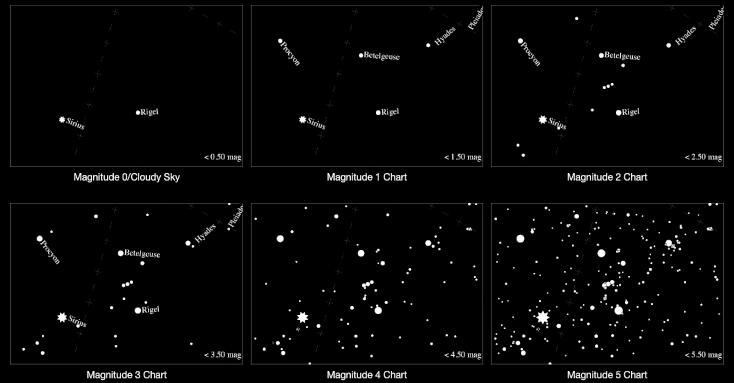
Researchers in Germany analyzed tens of thousands of observations made by citizen-scientists between 2011 and 2022 as part of the "Globe At Night" project. The organizers ask participants to first locate familiar constellations in the night sky. They present maps of those constellations showing differing numbers of stars to show varying degrees of skyglow. The participants decide among the charts which best matches their own local night skies. This provides robust estimates of night sky brightness that scientists can compare against other sources of data about light pollution.
Picture
Globe At Night charts for the constellation Orion. To estimate the brightness of the night sky, participants compare these charts to the night sky from their locations and find the best match.
The new work is the first large-scale analysis of the Globe At Night estimates. Until now, Earth-orbiting satellites provided the only global view of light pollution. Earlier studies involving satellite images concluded that light pollution on the ground grew at a much slower pace. A 2017 study concluded that the rate was around two percent per year in the first half of the last decade. 

Satellites flying blind

The new estimate in Science looks up from the ground instead of down from space, which may explain some of the difference. The satellites used to gather the night-lights data don't see blue light at all. They were not designed to make light pollution measurements in particular, so their onboard sensors aren't ideal for the job.

Their insensitivity to blue light is a problem given how the color of light at night continues to change. Since around 2010, many cities across the world converted their stock of public lighting to new, white light-emitting diode (LED) technology. They did this in hopes of realizing major reductions in energy use and financial cost with these energy-efficient light sources.

But white LED emits a lot more blue light than earlier lighting technologies. Satellites thus tend to under-count the amount of light at night they receive in space. That same blue light also scatters more strongly in the atmosphere than other colors. All other factors being equal, that effect explains in part why nights are getting brighter.
Picture
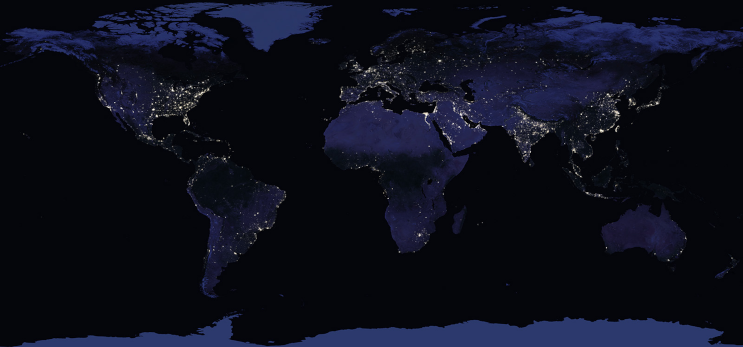
 A global composite view of the Earth at night in the year 2015 made from artificially colored orbital satellite data. The relative 'blindness' of satellites to blue light means images like this underrepresent the true extent of night lights on our planet. Image courtesy of NOAA/NASA.
Besides to the color issue, satellites also miss some of the light directed upward from the ground because it becomes skyglow. Since they are above the atmosphere, satellites only detect light rays that reach them. Some of those rays never make it because they're redirected back down to the ground. So while ground-based observers saw their night skies brighten in the past decade, satellites recorded a much slower rate of change.

Furthermore, some light sources emit in ways that makes it unlikely their light will be seen directly in space. Sources like lit windows of buildings and illuminated signs emit light toward the horizon. Those sources are among the most important contributors to skyglow, but very little light they emit gets to the satellites. And there is evidence that at certain hours of the night, those sources dominate light escaping from cities.

Visual observers on the ground sense at least some of the "missing" light that satellites don't see. That way of estimating the brightness of the night accounts for both the increase in light emissions and a trend toward bluer sources. Citizen-scientists also extend the reach of light pollution studies. It's often easier to recruit them to count stars where they live than place light sensors in the field. That is especially true in very remote locations around the globe.

Citizen science for global change

But even considering that volunteers provided about 50,000 measurements in the preceding decade, the information is incomplete. Vast swathes of land contained no observers at all. That left scientists to make informed guesses in places like Africa, where satellites suggest night lights are increasing the fastest.

Although the study authors note that known methods of reducing light pollution yield reliable results, current initiatives aren't producing results. This concerns light pollution researchers and activists alike. Skyglow is one symptom of a larger problem involving overuse of artificial light at night. We know it has negative impacts on everything from wildlife to energy use, traffic safety, and more. It's about much more than whether we can see the stars at night.

As more people realize the seriousness of the issue, governments are taking note. Countries like Mexico have recently classified light pollution as a form of environmental pollution. This can bring the mechanisms of existing environmental laws to bear on the problem.

The failure to reduce light pollution has real and lasting effects on communities. Wasted outdoor light at night involves measurable social and financial costs. Yet the new study authors admit that these messages about light pollution might heard by governments if the data were better geographically distributed.

More people participating in Globe at Night would improve the reliability of the results. If the number of participants increased by a factor of 10, we would begin to see trends on scales smaller than whole continents. As lead author Christopher Kyba said, "If we could do that, we would surely find places that are doing better than average, and we could try to figure out what they are doing right."
0 Comments
Read More

Company

Services
Staff
​
Resources
​
Clients
Blog

Support

Terms of Use
​
Privacy policy

CONTACT

PMB 237
​9420 E. Golf Links Rd., Ste 108

​Tucson, AZ 85730-1317 USA
[email protected]
Picture
© COPYRIGHT 2021-2026. ALL RIGHTS RESERVED.